
Catégorie: lectures
Quatre Ans ! 444ème article ! rétrospective …
Voici le quatre cent quarante quatrième article de ce blog. Ca fait quatre ans que nous avons commencé une nouvelle vie à la campagne en nous installant dans un petit village de la région du Kansai, au Japon.
Une première surprise avec ce blog c’est d’avoir autant de lectrices et de lecteurs. Je me réjouis toujours de vos commentaires et de vos questions.
Une deuxième surprise c’est d’avoir encore des choses à raconter, après quatre ans.
Je suis tenté de retracer une mini chronologie de ce blog, car il y a eu plusieurs phases ou étapes. Et on pourrait résumer tout cela en: initiation du novice citadin à la vie à la campagne (au Japon).
Eté 2012
Installation dans le village. Premières impressions.

Nous étions encore bien naïfs, nous ne savions rien de la vie à la campagne.
Et nous avions encore peur des insectes.
On écrit aussi un peu sur notre maison japonaise. Qui avant les travaux n’était pas vraiment folichon.
Pour nous c’est une nouvelle vie, même si j’ai la possibilité de garder mon job en informatique, que j’effectue désormais à distance, à la maison.
Hiver 2012-2013
Une periode ou l’on essaie tout et où rien ne marche vraiment, faute d’expérience. Cela n’entame pas notre enthousiasme pour autant. Je me sens un peu comme Jean de Florette ….
Printemps – été 2013
Concert de rock punk dans le temple bouddhiste du village. Le bonze de notre village est délirant.
Nous faisons la rencontre de S. C’est un moment clef pour nous car c’est par l’intercession de S. que nous apprenons énormément par la suite.
L’histoire de notre initiation à la vie à la campagne est un peu comme un escalier dont nous gravissons les marches une à une.
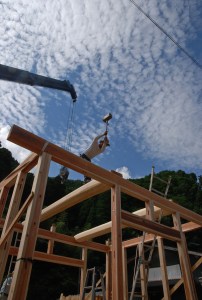
S. est charpentier, nous lui commandons la destruction d’une vielle batisse juste en face de notre maison, qui est en très mauvais état. Jadis construite pour l’élevage des vers à soie. A la place S. construit une petite maison de une pièce; selon les techniques de construction japonaises traditionnelles et avec le bois des arbres qu’il a coupés lui-même dans la montagne. Je passe beaucoup de temps à regarder comment il travaille. C’est beau et passionnant.
Hiver 2013-2014
Mes parents et ma tante nous honorent de leur visite et voyagent de France. Nous visitons un peu Kyoto qui n’est pas loin et passons beaucoup de temps dans le village. Ma mère prépare un civet de chevreuil qu’elle fait goûter aux voisins avec beaucoup de succès.
Nous construisons aussi ensemble un abri pour stocker notre bois.
Nous achetons un camion keitora. Ceci marque symboliquement notre appartenance à la campagne Japonaise.
Hiroshi nous donne un petit chaton abandonné, et nous le nommons Minou. Minou est très faible, malade, pleine de parasites. Mais en quelques semaines elle devient un chat magnifique.

En un an nous avons réalisé la puissance de la nature qui nous entoure au village. La beauté des insectes, des plantes, du ciel, de l’eau. Cette vérité que nous avions oubliée nous immerge. Et puis, marcher sur la terre lorsque nous jardinons, et le contact avec le bois.
Vivre dans une maison japonaise ancienne, faite de bois et de terre.. On est ainsi en permanence connecté avec l’univers et on se sent très très bien.
Un an après notre installation, nous savons que la ville (Tokyo) ne nous manque pas.
Une grande surprise aussi est la qualité des relations que nous entretenons avec nos voisins. Tout le monde est sympathique et nous a acceptés d’emblée. On comprendra plus tard que les gens étaient très contents de voir des gens s’installer avec un jeune enfant.
Ma femme bien que venant d’une région plus au sud s’est très bien habituée à la vie dans notre village et affirme ne vouloir retourner à Tokyo pour rien au monde. Quand à moi; vivre ici au village c’est comme vivre en France. Il y a de l’espace (plus qu’à Tokyo), de la nature (plus qu’à Tokyo) et les gens me foutent la paix (comme à Tokyo). Donc je ne sens aucun dépaysement. A part la distance avec la famille et le manque de fromage.
Et les discours de François Hollande nous rappellent à chaque fois que nous sommes très bien au Japon.
Printemps 2014
Pour une année, et suivant la rotation d’une maison l’autre, nous sommes chef du district. Ou rinpocho. Ca consiste surtout à collecter des sous chaque mois. Par contre, une personne âgée de notre district décédée, notre qualité de chef de district nous amène à jouer un rôle clef lors des obsèques.
On comprend alors combien les liens de confiance entre tous sont importants dans le village. Nous nous sentons aussi très intégrés.
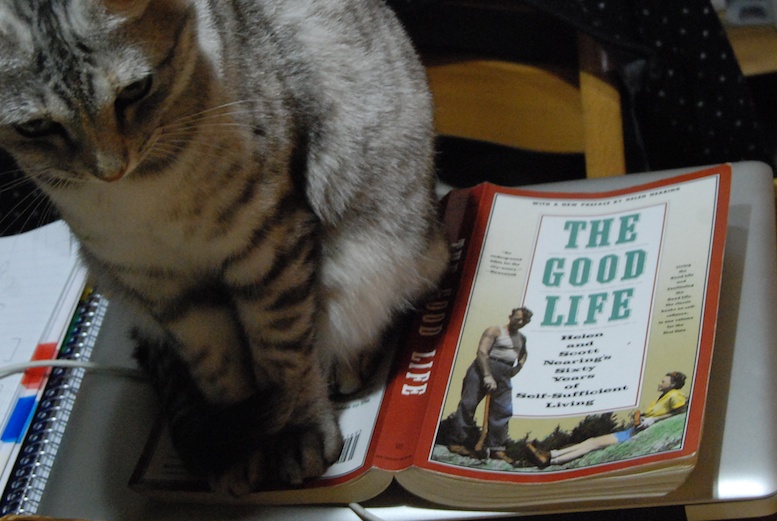
Lis the good life de Helen et Scott Nearing.
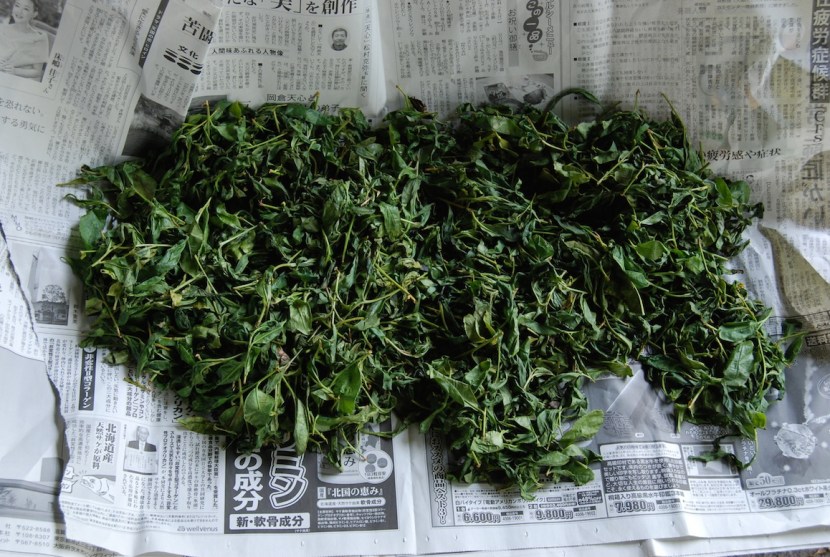
Nous récoltons du thé dans la forêt.
Eté 2014
Récolte un carton de pommes de terre.
Automne 2014
Nous faisons l’acquisition d’un bout de la montagne; juste en face de chez nous. Commence à débroussailler. La montagne deviendra par la suite un immense terrain de jeu et d’expérimentations. Ce moment marque vraiment notre passage à l’action.
Nous pouvons remodeler la montagne à notre guise. Mon projet est de réduire la quantité de cryptomères, dégager la jungle et les broussailles et planter une grande variété d’arbres, afin que la nature puisse repartir et se re développer.
Le contact avec la terre aussi nous fait toujours du bien. Chaque personne sur cette planète devrait avoir son petit lopin de terre et y faire des trous. Le monde irait bien mieux.
On pense au concept de grounding où justement on est connecté à la terre.
Commence aussi une longue relation avec les sangsues.
Des visions de moissonneuses de riz transformée en robots gundam.

Hiver 2014 – 2015
Découvre dans une montagne voisine un cerisier géant et écroulé. Il s’appelle ‘cerisier éléphant‘. Je le débite et le ramène à la maison. Bonne expérience avec la tronçonneuse. Dois doubler la capacité de notre abri bois.
Je finis ma première Bande Dessinée Tout Ira Bien. Dernière page publiée sur le blog !
Dans la montagne, plante les premiers arbres.
Minou commence à se promener dans la montagne, en notre compagnie.
Printemps 2015
Visite de Kristophe Noel, photographe, rencontré via ce blog.
L’ecole maternelle du village ferme, faute d’enfants. Le vieillissement de la population et le peu d’enfants est un très gros problème Japon et va aller de mal en pis.
Je me relance dans le jardinage mais je l’avoue sans trop de succès, à cause de mon boulot trop busy et de mon manque de focus.
Eté 2015
Pourtant le thème de l’agriculture continue de me passionner; et je lis un excellent book sur la permaculture et autres méthodes.
Automne 2015
Autre signe que les choses commencent à partir sérieusement en rouille avec la diminution de la population; la superette du village ferme.
Hiver 2015-2016
Travaille de nouveau dans la montagne. Dégage la deuxième terrasse. Plante une vingtaine d’arbres.

Publie ma bande dessinée Tout Ira Bien. à compte d’auteur. Le résultat; imprimé, est vraiment convaincant. Vends sur le net. Versions Française et Anglaise.
Exposition photo de Kristophe Noel dans un café du village. Portraits des habitants.
Fais la connaissance de TS, un jeune agriculteur de la région, éduqué aux Etats Unis. On parle en Anglais. Par la suite je fais connaissance avec quelques étrangers établis ici, ce qui est une première, et un soulagement un peu de ne pas être me seul étranger de la région.
S. donne un coup de main et coupe une dizaine d’arbres dans notre montagne. Des cryptomères.
Printemps 2016
Notre fils rejoint l’équipe de baseball du village.
S. propose d’utiliser le bois des arbres de notre montagne et de construire un truc avec. Commence alors le projet de Technology Transfer: je vais travailler les week ends dans l’atelier de S., S. m’enseigne les ficelles de son métier. C’est passionnant. On aimerait devenir charpentier !
Eté 2016
444è article de ce blog.
Lecture: Permaculture

permalecture
- Editeur : ACTES SUD (10 septembre 2014)
- ISBN-10: 2330034342
- ISBN-13: 978-2330034344
Lecture: Le Sol
Quick update on the webcomic Everything will be fine (English Version)
Just a FYI to our English speaking followers (thank you). We started to publish the English version of our webcomic !
The title in English is « Everything will be fine ».
The comic is an alegory inspired from the events that followed the nuclear crisis that hit Japan and Fukushima in March 2011. It happens in a fantastic world, a mix of medieval world with giant insects, pig, rats and humans. It is a fable more than anything else.
Though in a fantastic world, the events and the story line are all about what happens in the aftermath of a nuclear accident, like Fukushima or Tchernobyl.
Link to the English version : http://wakametamago.wordpress.com
Link to the French version: http://toutirabien.me
Thank you 🙂

everything will be fine title
The Good Life
- ISBN-10: 0805209700
- ISBN-13: 978-0805209709
- http://www.amazon.fr/dp/0805209700
- p.5 We left the city with three objectives in mind
- p.31 We would attempt to carry on this self-subsistent economy by the following steps: (1) raising as much of our own food as local soil and climatic conditions would permit. (2) Bartening our products for those which we could not or did not produce. (3) Using wood for fuel and cutting it ourselves. (4) Putting up our own buildings with stone and wood from the place, doing the work ourselves. (5) Making such implements as sleds, drays, stone=boats, gravel screens, ladders. (6) Holding down to the barest minimum the number of implements, tools, gadgets and machines which we might buy from the assembly lines of big business (7) If we had to have such machines for a few hours or days in a year *plough, tractor, rototiller, bulldozer, chainsaw), we would rent or trade them for local people instead of buying and owning them.
- p.32 Ideas of « making money » or « getting rich » have given people a perverted view of economic principles. The object of economic effort is not money, but livelihood. Money can not feed, clothe or shelter. Money is a medium of exchange,-a means of securing the items that make up livelihood. It is the necessaries and the decencies which are important, not the money which may be exchanged for them.
- p.33 Under any economy, people who rent out money live on easy street. Whether as individuals or banking establishments, they lend money, take security and live on a rich harvest of interest and the proceeds of forced sales. The money lenders are able to enjoy comfort and luxury, without doing any productive labor. It is the borrowing producers who pay the interest or lose their property. Farmers and home owners by the thousands lost everything they had during the Great Depression because they could not meet interest payments. We decided to buy for cash or not at all.
- p.35 We believe that all life is to be respected -non human as well as human. Therefore, for sport we neither hunt nor fish, nor do we feed on animals. Furthermore, we prefer, in our respect for life, not to enslave or exploit our fellow creatures. Widespread and unwarranted exploitation of domestic animals includes robbing them of their milk or their eggs as well as harnessing them to labor for man. Domestic animals, whether cows, horses, goats, chicken, dogs or cats are slaves. Humans have the power of life or death overt them. Men buy them, own them, sell them, work them, abuse and torture them and have no compunctions against killing and eating them. They compel animals to serve them in multitudinous ways. If the animals resist, rebel or grow old, they are sent to the butcher or else are shot out of hand.
- p.91 The keystone of our economy was our food supply. As food costs are the largest single item in the budget of low income families, if we could raise most of our food instead of buying it on the market, we could make a substantial reduction in our cash outlay and in our required cash income. (…) This decision brought us face to face with three stubborn facts, the Vermont climate, the pitch of the land, and the depleted soil.
- p.121 most of the food consumed by human beings comes directly from the upper few inches of top soil. A whole soil is one that contains the ingredients necessary to produce sturdy healthy vegetation of the required variety and species. Different plants have different nutritional needs and offer various combinations of minerals, vitamins and enzymes to the animals and humans who consume them. Soil wholeness may be upset by erosion, by cropping, by improper fertilizers. Until the solid balance is restored, the products of an unbalanced soil will be unbalanced vegetation. If such vegetation is consumed, it may transfer its unbalance to the user, causing a person who eats « good food » by ordinary standards, to be far from well.
- p.122 Good food should be grown on the whole soil, be eaten whole, unprocessed and garden fresh. Even the best products of the best soils lose more or less of their nutritive value if they are processed. Any modification at all is likely to reduce the nutritive value of a whole food. Peeling tomatoes, scrapping carrots, milling wheat, cooking green peas, removes essential partis of the food, causes chemical changes, or drives off vitamins.
- p.142 We were looking for a kindly, decent, clean and simple way of life. Long ago we decided to live in the vegetarian way, without killing or eating animals; and lately we have largely ceased to use dairy products and have allied ourselves with the vegans, who use and eat no animal products, butter, cheese eggs or milk. This is all in line with our philosophy of the least harm to the least number and the greatest good to the greatest number of life forms.
- p.144 Apply to vegetables and fruit the principles of wholeness, rawness, garden freshness, and one or few things at a meal, and you have the theory of our simple diet. In practice, the theory gave us a formulated regime, fruit for breakfast, soup and cereal for lunch, salad and vegetables for supper. (…) We often had a one-day exclusive apple diet to revivify and cleanse the system. (…) Gourmets amongst us dipped whole bananas in honey and then in wheatgerm. Quarter sections of apples were dipped the same way, or spread with peanut butter. Nuts were often cracked and eaten with the apples. Berries were served with maple syrup or honey, or eaten dry. Breakfast was rounded up by a handful of sunflower seeds, herb tea sweetened with honey, or a tablespoon of blackstrap molasses in hot water.
- p.145 We have gone for months at a time with no breakfast at all and maintained health and suffered no discomfort though carrying on a full program of work. For ten years we have eaten fruit for our first meal of the day, and yet put in four solid hours of hard physical or mental work until lunch. We felt better, worked better and lived better on it than after a stuffy starch, protein-rich breakfast.
- p.148 All of our meals were eaten at wooden plank table, in wooden bowls, the same bowl right through the meal. This practically eliminated the dish washing problem. With no sauces, no frying and the like, there were few dishes to wash and pans to scrub. (…) We also felt than wooden eating utensils were more neutral and modified the flavor less than the metallic table tools.
- p.151 Livelihood is the central core around which most people build their lives. (…) The majority of human beings, notably in industrial communities, dedicate their best hours in their best years to getting an income and exchanging it for the necessaries and decencies of physical and social existence. Children, old people, the crippled, the sick, the voluntarily parasitic are at least partially freed from livelihood preoccupations. Able bodied adults have little choice. They must meet the demands of livelihood or pay a heavy penalty in social disapproval, insecurity, anxiety and finally in physical hardship.
- p.153 Thoreau said on cutting one’s own fuel: » It warms us twice, and the first warmth is the most wholesome and memorable, compared with which the other is mere coke… The greatest value is received before the wood is teamed home. »
- p.154 Our purpose (…) was not to multiply food, housing, fuel and the other necessaries, but to get only enough of these things to meet the requirements of a living standard that would maintain our physical efficiency and at the same time provide us with no end in itself; rather it was a vestibule into an abundant and rewarding life. Therefore we produced the necessaries only to a point which would provide for efficiency. When we reached that point we turned our attention and energies from bread labor to avocations or to social pursuits.
- p.155 Mark Twain: Civilization is a limitless multiplication of unneccessary necessaries. A market seeks by ballyhoo to bamboozle consumers into buying things they neither or want, thus compelling them to sell their labor power as a means of paying for their purchases. Since our aim was liberation from the exploitation accompanying the sale of labor power, we were as wary of market lures as a wise mouse is wary of other traps.
- p.158 City dwellers, accustomed to a wide variety of services, get to a point at which they believe that the essential questions of day to day living can be settled by arrangement, chiefly over a telephone. A customer with a ten dollar bill can get wonderful results in a department store. But put the same person in the backwoods with a problem to be solved and an inadequate supply of materials and tools. There money is useless, Instead, ingenuity, skill, patience and persistence are the coin current. The store customer, who comes home with a package under his arm has learned nothing, except that a ten dollar bill is a source of power in the market place. The man or woman who has converted material into needed products via tools and skills has matured in the process.
- p.159 William Cooper « It is not large funds that are wanted, but a constant supply, like a small stream that never dies. To have a great capital is not so necessary as to know how to manage a small one and never be without a little. »
- p.192 We are opposed to the theories of a competitive, acquisitive, aggressive, war-making social order, which butchers for food and murders for sport and for power. The closer we have to come to this social order the more completely are we a part of it. Since we reject it in theory, we should , as far as possible, reject it also in practice. On no other basis can theory and practice be unified. At the same time, and to the utmost extent, we should live as decently, kindly, justly, orderly and efficiently as possible. Human beings, under any set of circumstances, can behave well or badly. Whatever the circumstances, it is better to love, create and construct than to hate, undermine and destroy, or, what may be even worse at times, ignore and lassoer passer.
A handmade life
Je viens de finir A Hand made life – in search of simplicity de Wiliam Coperthwaite.


Vous devez être connecté pour poster un commentaire.